

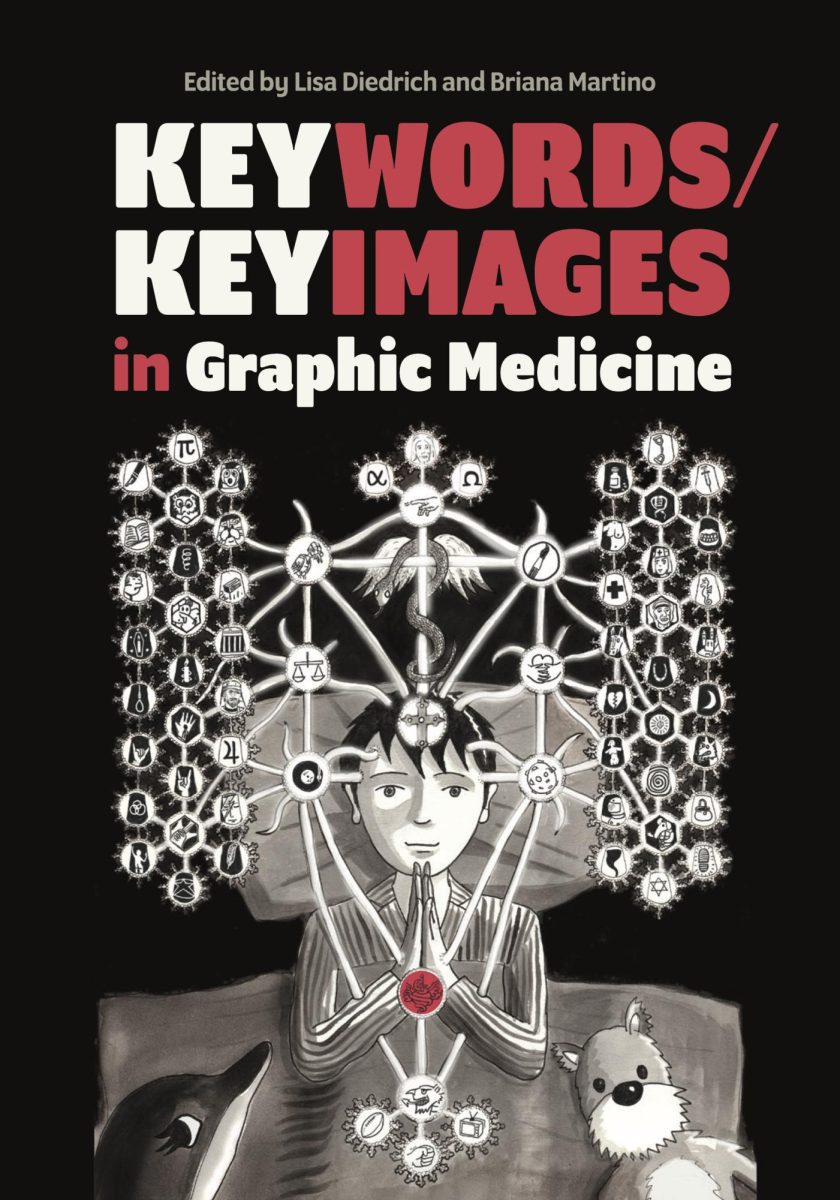
“Keywords/Keyimages in Graphic Medicine,” a book co-edited by Simmons Associate Professor Dr. Briana Martino and Stony Brook University Professor of Women’s, Gender, and Sexuality studies Dr. Lisa Diedrich, will be released on February 3 after six years of work.
Though “keywords” already existed as a word and style of academic book meant to display important terms in relation to bigger topics, the term “keyimages” was coined by the editors for this book. It describes the use of visuals made to help represent a larger idea. “Graphic medicine” is an umbrella term that describes the usage of comics to represent healthcare, illness and disability.
The educational book features work from about 36-40 contributors over 37 chapters, with contributors consisting of artists, doctors, nurses and scholars. Each chapter focuses on a specific keyword or keyimage related to graphic medicine that’s then expanded on by the creator. These chapters will be split across the five different areas of the book: practice, pedagogy, politics, process and personal/autobiographical.
“It’s an academic space, but it’s a space where people from all over the campuses and all over the professions come together,” said Martino.
Dr. A. David Lewis, Associate Professor of English and Health Humanities at Massachusetts College of Pharmacy and Health Sciences, is one of the contributors to “Keywords/Keyimages”. He has a chapter covering cancer, hoping to serve as an introduction into cancer in comic books.
“In addition to doing a discussion of various titles that cover cancer in the comic book medium, I also offer a few ways we could divide those, if only to make the very large subject a little more manageable, or a little more approachable,” said Lewis, who has been contributing to scholarly work about comics for nearly 10 years, with his own upcoming book, “Body, Soul and Comics” releasing soon.
Lewis first began work on “Keywords/Keyimages” after hearing about it at a yearly graphic medicine conference, where Martino and Diedrich first started asking for proposals for the book in 2021. Other contributors include Ian Williams, who first coined the term “graphic medicine.” Maia Kobabe, known for creating the graphic memoir “Gender Queer” also serves as a contributor. After choosing all the contributors, Martino and Diedrich spent 2-3 years working with them on their chapters.
“It was interesting to think about how to work with authors in shaping their pieces, as well as how to make the whole volume cohesive,” said Martino, who finds a way to incorporate graphic novels into each class that they teach.
Martino’s interest in graphic medicine stems from their psychiatric background, as well as their experience being a queer person and creating media. This interest has been shared with Diedrich ever since the two met at Stony Brook, with Diedrich being Martino’s dissertation advisor. Since then, they continued to discuss graphic medicine, before beginning to work on the book in 2019.
Diedrich specified that co-editing a book was a “very different experience” than her other academic work, even within other “keywords” volumes for different subjects. She said she found that “Keywords/Keyimages” would have a less strict format in comparison, such as not having specific word counts for chapters, though there was a maximum of five to seven graphics per chapter.
“We wanted there to be much more flexibility in terms of how people presented what their chapters looked like,” said Diedrich.
With a few weeks till release, Dr. Martino finds themself “so excited” and “very grateful to all of our contributors for their incredible work.”


A. David Lewis • Jan 21, 2026 at 4:10 pm
Thank you so much for this coverage, Mattea. Not only is it well written, but it also nicely captures the array of voices and views that contributed to the overall work (led by Profs. Martino & Diedrich, of course). I’m delighted to share this article with my network!