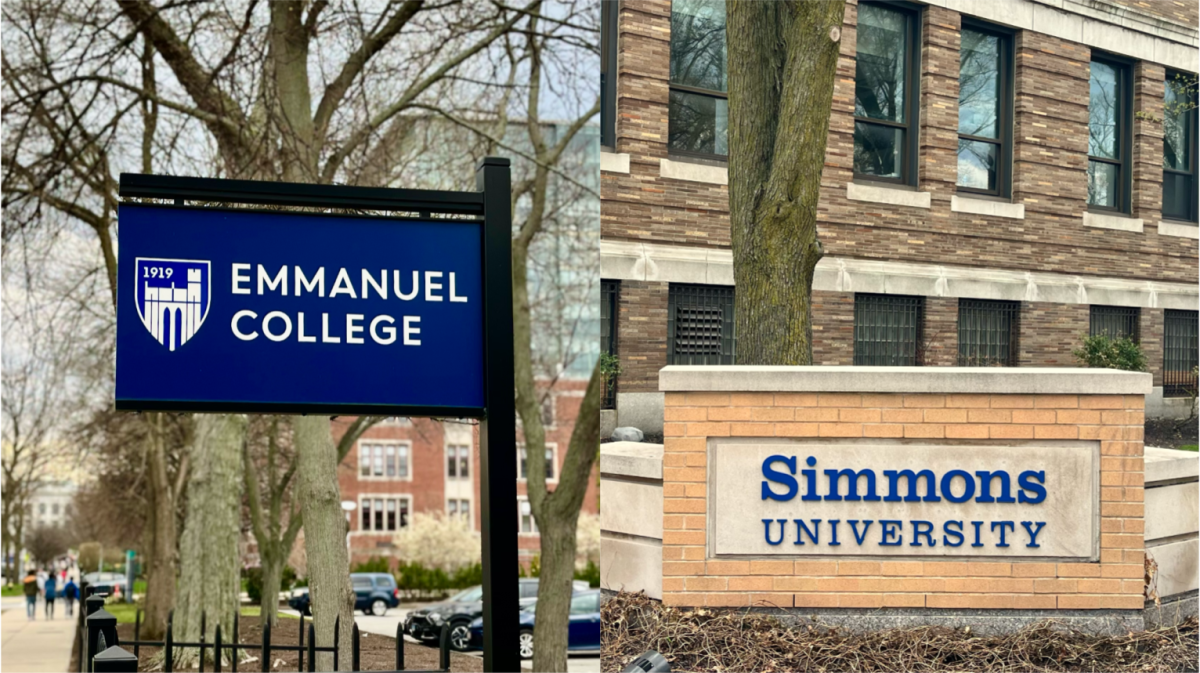



In a decision made shortly before the end of the Fall semester, the Simmons University Board of Trustees voted to discontinue three undergraduate majors and one graduate major. They have also voted to replace the Humanities department with two new departments.
In an email sent to students on the last day of classes, the Office of the President outlined the decision to eliminate the undergraduate majors in accounting, humanities, and applied Spanish, alongside the graduate major in Gender and Cultural Studies. The humanities major and department, which has only been open for one full year, is also being replaced by two new departments: History and Literature and Writing. Applied Spanish will be reclassified as an applied Spanish certificate,
The proposal shifted a number of times before going to the Board of Trustees. The initial idea presented to students included the undergraduate majors Public Health, Economics, Physics, Mathematical Sciences, and Chemistry.
The communication emphasizes that current students enrolled in these programs will not experience an interruption to their degree, stating that they are “devoting resources to ensure that all students are fully supported as [they] successfully complete [their] degree,” although no new students will be enrolled in discontinued programs as of May 1, 2026.
In a sentiment that has been repeated numerous times since the initial town hall meeting with students, Provost Stephanie Cosner and President Lynn Perry Wooten said they “engaged faculty, departments, and students and reviewed enrollment trends to ensure our academic programs continue to align with student interest and demand.”
Financials
This decision comes at a time of financial stress for Simmons University. In October, Moody’s Ratings, a credit rating agency focused on risk analysis of businesses and governments, downgraded Simmons’ rating from Baa3 to Ba2. This rating means that the university is “judged to have speculative elements and are subject to substantial financial risk,” according to Moody’s descriptions and definitions of methodology.
“Simmons, like all colleges and universities across the country, is navigating a significant period of disruption due to the changing higher education landscape, increased competition, rising operating costs, and evolving federal policies,” said Meghan Kass, Vice President, Chief Financial Officer (CFO), and Treasurer of Simmons University, said in an email statement to the Voice. “Against this backdrop, Simmons continues to identify opportunities to strengthen our financial resiliency while maintaining our commitment to affordability for students.”
Although the higher education sector is also under financial pressures, with Moody’s having downgraded the outlook to “negative” for the sector as a whole, Simmons University has retained the “negative” outlook assigned by Moody’s since 2023. Simmons held a “negative” outlook in 2020 and 2021 as well, before being marked as “stable” in 2022.
Moody’s rating rationale cited $269 million of outstanding debt at the end of the 2025 fiscal year, which is reflected within the yearly financial statements released. When reviewing bonds payable, which follows different loans and debt, the debt has decreased from 2024 to 2025.
In a further review of the 2024 financial statements, Simmons University took out a loan, identified as “Series N.” Part of this loan was used to pay off a previous loan, which was originally set to be paid off in 2039, while “the remainder represents new money to be used for capitalized interest and capital expenditures,” according to the financial documents.
When asked about the purpose of the varying loans, CFO Kass said, “Collectively, these loans enabled us to make key investments in our students and our university – as they financed the construction and renovation of much of our academic campus. Since 2000, Simmons has built the Palace Road and Drinan academic buildings, including the underground parking garage, and completed major renovations to the Lefavour Building for the science and library spaces. We have also upgraded essentially every space on the academic campus to create more modern, student-focused environments and improve accessibility in alignment with ADA standards.”
In an interview before the Board Meeting occurred, President Wooten talked about how this rating “speaks to our ability to borrow money for things such as capital improvements,” while the academic portfolio is “funded by tuition revenue, some of our alternative revenue, and the revenue we also get from philanthropy and our endowment.”
When asked about the financial connection to the academic portfolio, Kass stated that “academic programs make up the largest portion of the university’s expenses, including faculty salaries, classroom technology, instructional materials, and academic support services. Because academics are core to our mission and our budget, we continuously review all expenses to ensure we are using university resources responsibly and aligning them with student needs and strategic priorities.”
Despite academic programs making up the largest portion of the University’s expenses, they “do not record revenue and expenses by major,” according to CFO Kass.
About $86 million dollars of Simmons’ operating expenses came from instruction and academic support in the 2025 fiscal year. Although one of the larger portions of this expense, at $37 million dollars, is salaries and wages, about $20 million dollars comes from a partner share of the program “2U,” used in the graduate programs.
The graduate program was discussed more in the annual letter from the current CFO, this year, as Kass. Student revenue declined by $9 million “due to an $8 million reduction in online graduate program revenue.” The operating expenses also decreased by $5.9 million from 2024, but this change comes from the decline in graduate revenue, resulting in a lower payout, specifically a $6.1 million reduction, to “2U.”
Undergraduate programs made up 41% of Simmons’ revenue in the 2025 fiscal year, while 59% came from graduate programs.
In CFO Kass’s statement, she said “We are actively executing a multi-year strategy that includes strengthening operations, responsibly growing revenue, and most importantly, shaping professionally focused undergraduate and graduate experiences that enable students to rise, thrive, and lead in their careers. One Simmons is also a critical investment in our students, our campus, and our future, and we are committed to leveraging opportunities created by this once-in-generation project.”
“As we move forward, we will continue to identify opportunities to improve our financial sustainability and ensure we can fulfill our vital mission for generations to come,” concluded CFO Kass.
Faculty Reflections
In a similar manner to Humanities, the Applied Spanish major has also only been in existence for one year, although Spanish itself was offered at the university for many years prior.
“We are saddened by the closure of the Applied Spanish major, which was a fairly new major. The Spanish program, however, has a long history at Simmons. For decades, faculty members were committed to academic excellence,” said Professor Dánisa Bonacic, Program Director of the Applied Spanish major and minor, in a statement to the Voice. “Our graduates gained practical benefits from learning Spanish: they traveled abroad, pursued graduate studies, became teachers, social workers, nurses, and pursued many other career paths.”
Spanish will continue in another form at Simmons with the “Certificate of Advanced Spanish for Nursing and Healthcare Professionals,” where the main objective is to “empower students to participate in discussions and express their perspectives about complex issues related to public health, mental health, bioethics, bilingualism, and cultural differences,” according to Professor Bonacic.
As for students currently in the program, she went on to express her pride for “for choosing to learn a second language to communicate with people from different countries and cultures” and emphasized that they will “continue to support them and guide them on a path to graduation.”
With closures also comes faculty loss. In an interview with the Voice, Professor Wanda Torres Gregory, Chair of the Humanities Department and Simmons professor of 30 years, talked about what the sunsetting process means for her and other faculty members of majors that were cut.
“There’s a lot of dedicated professors that are leaving. I’m leaving, I’m retiring. I didn’t want to retire, but they did offer a good separation package,” Professor Torres Gregory said, “I would have stayed… but I don’t see a future for my discipline.”
Following the 2023 sunsettings, Professor Torres Gregory designed the new Humanities major. In this transition, they saw the loss of faculty, specifically in the Art and Music majors, who decided to leave, some taking retirement agreements.
In the absence of full-time faculty, adjunct faculty taught many courses that aligned with sunsetted majors. But adjunct professors do not function as academic advisors.
“That doesn’t do justice. I do my best, but I’m not an art professor, and you know, it would have been great for them to have advisors in that field,” reflected Professor Torres Gregory on her own time advising.
Rather than forming a new department, as Simmons did with the Humanities Department, the idea would be to form a “General Studies” division. This would hold courses from disciplines that have been sunsetted. But with this division comes uncertainty.
“My hope is that we will continue to offer Humanities. My fear is that the offerings will decrease significantly and the variety as well,” Professor Torres Gregory said, “For example, philosophy, we have only 10 courses, but those 10 courses have a huge presence in the general education curriculum.”
Philosophy of Mind is a required course for Neuroscience & Behavior majors. Professor Torres Gregory also reflected on the popularity of different courses within nursing majors and the importance of liberal education.
“This is a loss for [students] in terms of variety and of depth,” she said, “because that means that, eventually, you won’t be able to take a course that takes you into any great depth, into philosophy, into art.”
In a brief statement to the Voice, Dr. Ray Pfeiffer, a professor of accounting at Simmons who has over 30-years in higher education dedicated to his career, reflected, “I am deeply sad that Simmons will no longer have an accounting major. I’m sad for myself and my current students, as we inevitably feel a bit of diminishment at the notion that the accounting major isn’t important enough to Simmons to be retained.”
“I’m sad for future Simmons students who will not have the option to choose accounting as a major and career,” he continued. “And I’m sad for Simmons that these financial pressures are forcing the closure of highly relevant and successful programs like mine.”