

In an interview with The Voice, President Lynn Perry Wooten and Provost Stephanie Cosner outlined the final proposal on revisions to the academic portfolio to be submitted to the Board of Trustees today, Dec. 11th.
This proposal was initially outlined to students, who further gave feedback, in a town hall meeting held by the Office of the Provost.
In terms of structural shifts of the undergraduate program, Provost Cosner stated, “We are proposing to move the Department of Physical Therapy to the School of Nursing. We are proposing to close the humanities department. We are proposing to start or restart an independent history department in Ifill, [and] to start a literature and writing department in Ifill.”
As for “sunsetting,” the undergraduate majors presented to the board will be accounting, applied Spanish, economics, humanities, and physics. According to Provost Cosner, the physics major will be proposed alongside “an opportunity for faculty to create a new physics major.”
She later expanded on the applied Spanish major, noting the possibility of an applied Spanish certificate “seeing our students are really interested in Spanish as an add-on to professional degrees versus a major.”
On the graduate level, they are proposing to sunset the Gender and Cultural Studies master’s program.
Provost Cosner emphasizes to students in the majors decided to be sunset “you’ll be individually supported during this process, not only from your advisor and your major area in your department, but also from the Provost Office centrally.”
The humanities and applied Spanish majors are already adapted majors that came from the 2023 sunsetting. The criteria of whether or not a major is sunsetted, according to Provost Cosner, is determined through meetings and data, specifically “enrollment, student interest, admissions, interest, course utilization, course interest in registration, financial and resource implications.”
Many students feel out of the loop and upset by the sudden changes in the school’s structure.
“Personally, I don’t like it especially if they are cutting programs in the arts and sciences. I feel like Simmons brands itself as such a mainly women’s centered institution that educates and empowers women but then they’re taking away such vital and important courses,” reflected sophomore nursing student Kemaya Lendore.
When asked how this could change student culture at Simmons, Kaitlyn Frye, a sophomore double major in Communications and Economics, said “there’s already such a strong divide between majors – STEM nursing versus STEM sciences versus communications and humanities. I feel it only furthers the divide… It’s easy for us to create a culture where we feel pitted against each other instead of a unified student body.”
Some people noted that students are already looking at the possibility of transferring. Lyn Santiago, an undeclared sophomore, said “I have heard of people wanting to transfer to places like Emmanuel. A lot of people don’t like how we are not staying super liberal arts focused. Even though we have lots of STEM majors, we see lots of cuts within the STEM majors which makes students feel like they don’t care about any majors.”
Revisiting sunsetting majors two years later also took faculty by surprise. In an interview with the Voice, Jennifer Roecklein-Canfield, Faculty Senate President and Professor of Chemistry, described the process through the lens of the Faculty Senate.
As stated in the Town Hall, Provost Cosner met with the Board of Trustees in August. The Faculty Senate later requested a meeting the first week of September, after seeing the Board of Trustee meetings scheduled over the summer.
They met with Provost Cosner, President Wooten, and the Board of Trustees Chair. At that point, all that had been determined was “that Simmons University was going to remain an independent, women’s centered University,” according to Professor Roecklein-Canfield.
In comparison to the 2023 sunsetting, Professor Roecklein-Canfield noted the changes.
“We were also surprised by the speed with which we would have to make these decisions. Last time the process took more than a year, if not longer, to go through all of the deliberations… giving faculty ample opportunity to see what was going to be happening,” she said.
There was also discussion about whether the six school structure was best for maintaining financial stability.
When asked about what would happen to faculty if their department area was to be sunsetted, Provost Cosner confirmed there is the possibility of faculty cuts within this plan.
She also presented the two possibilities of either creating “service related departments that would house faculty who are in a discipline that do not have a major” or “more likely… would be to integrate them into closely aligned fields, so that those faculty still have a strong academic home.”
When asked if they had a message for students, President Wooten said, “The student voice is critical. While I talk to students about that, we look at your most significant way of sharing what you’re interested in, by what you major in, what courses you enroll in, you have perspectives about the experience that are important for us to hear. We want that door to be open.”
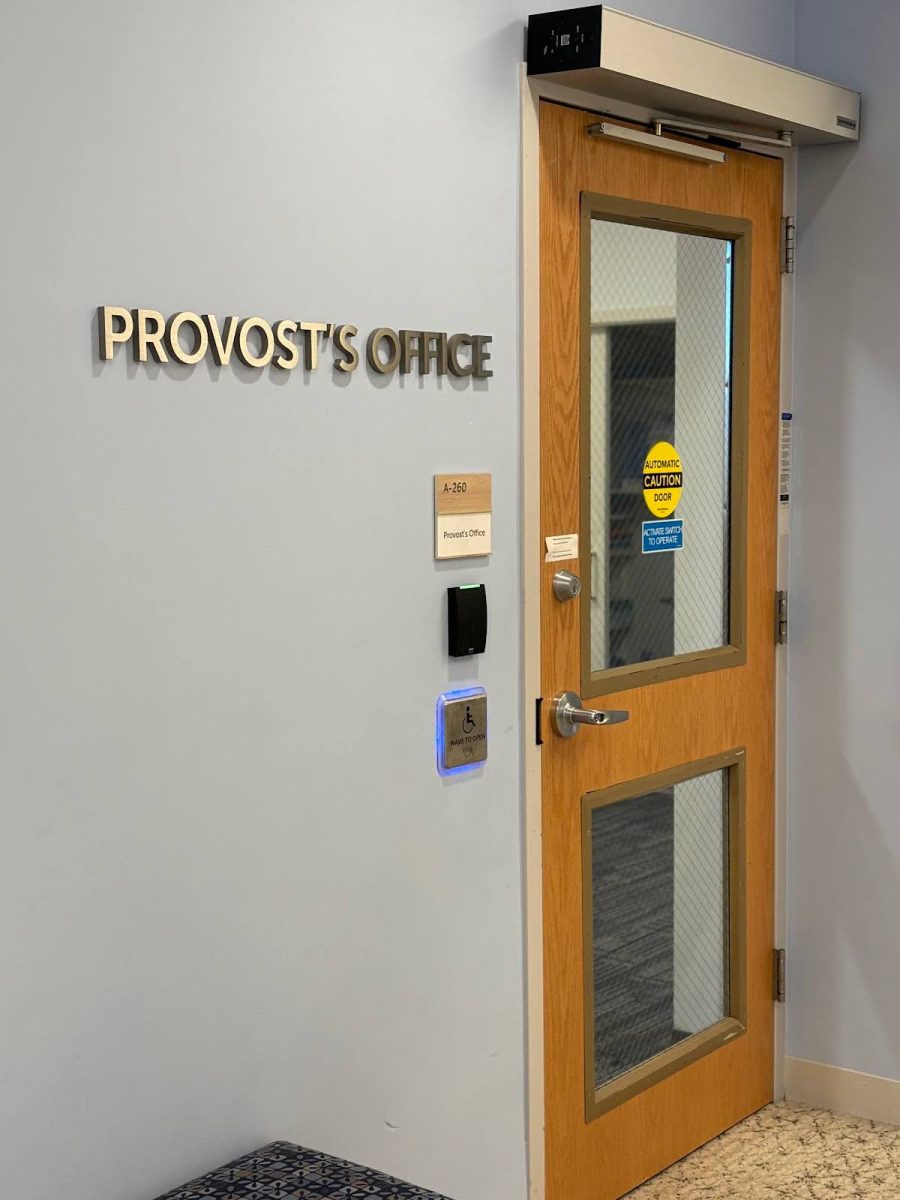
She also emphasizes, “Both the Provost and I have open door policies, and we believe in the philosophy of community and collective work. So any feedback that students have, I appreciate that. Send me an email. Come by my office.”